Good Hurdle Times for High School: 110m, 100m, 300m
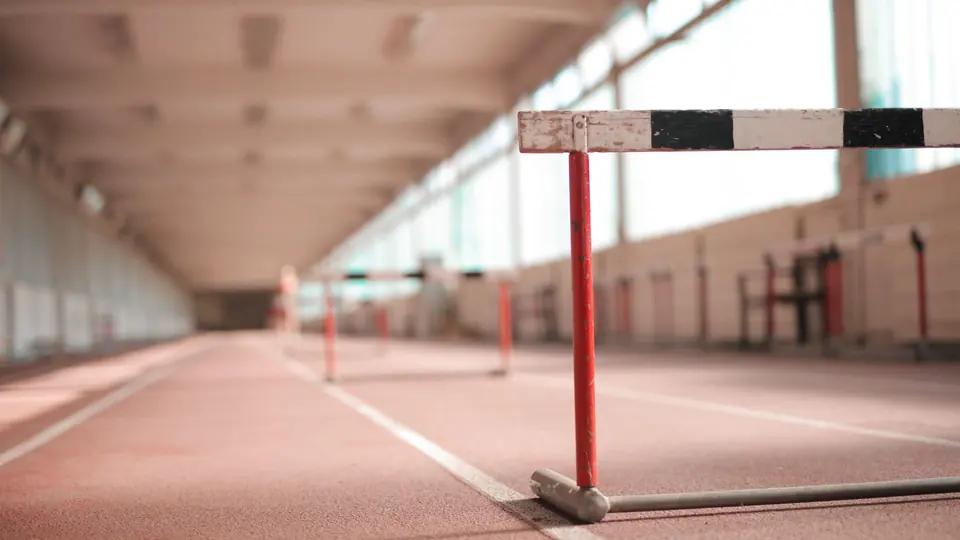
Good hurdle times for high school climb in published steps. Idaho's 2026 state qualifying standards for boys run from 15.86 in class 2A to 14.43 in class 6A in the 110m hurdles, and from 41.46 to 38.33 in the 300m hurdles. For girls they run from 16.32 to 15.03 in the 100m hurdles and from 47.41 to 45.63 in the 300m. The Division I recruiting range is 14.10 to 15.70 for the boys' 110m hurdles and 13.50 to 14.10 for the girls' 100m hurdles.
Every row below is a named standard or the college range this site publishes, and nothing is estimated. The CIF-SS, Idaho and FLYRA times are FAT; Missouri's sheet does not name a timing method. Three races share this page because the hurdles change between levels. Boys race 39 inch hurdles in high school and 42 inches in college, girls race 33 inches at both, and the 300m hurdles has no college version at all. To place your own time, the 110m hurdles rating tool and the 100m hurdles rating tool show the division a time reaches and the gap to the next one.
The 110m and 100m hurdles, by level
| Level | Boys 110m hurdles | Girls 100m hurdles | Where the number comes from |
|---|---|---|---|
| Middle school championship qualifier | 16.40 (100m, 33 inch hurdles) | 18.00 (100m, 30 inch hurdles) | FLYRA 2026, Florida's middle school state meet, grades 5 to 8 |
| Varsity: advancing from league finals | 16.14 to 18.74 | 17.04 to 18.74 | CIF Southern Section 2026 minimum standards, Division 1 to Division 4 |
| Section or district qualifier | 14.76 to 16.96 | 15.05 to 16.94 | CIF-SS 2026 at-large standards; Missouri MSHSAA 2026 district standards, 15.10 to 16.66 for boys and 15.42 to 16.94 for girls |
| State-qualifier level | 14.43 to 15.86 | 15.03 to 16.32 | Idaho IHSAA 2026 state qualifying standards, classes 6A to 2A |
The 300m hurdles, by level
| Level | Boys, 36 inch hurdles | Girls, 30 inch hurdles | Where the number comes from |
|---|---|---|---|
| Middle school qualifying standard | 45.00 | 53.00 | FLYRA 2026; the race is not run at its state meet, the time qualifies for a similar event, and no hurdle height is listed |
| Varsity: advancing from league finals | 41.74 to 46.14 | 48.74 to 52.84 | CIF-SS 2026 minimum standards, Division 1 to Division 4 |
| Section or district qualifier | 39.27 to 43.23 | 45.25 to 49.19 | CIF-SS 2026 at-large standards; MSHSAA 2026 district standards, 40.02 to 43.23 for boys and 45.95 to 49.19 for girls |
| State-qualifier level | 38.33 to 41.46 | 45.63 to 47.41 | Idaho IHSAA 2026 state qualifying standards, classes 6A to 2A |
Sources, all 2026 and all times as published: CIF Southern Section minimum and at-large standards, the CIF-SS track and field playoff bulletin, MSHSAA district qualifying standards, Idaho IHSAA state qualifying standards and the FLYRA qualification standards. The bulletin sets the Southern Section rules: a league champion goes to the divisional prelims automatically, second and third place go with the minimum standard, fourth place or lower needs the at-large standard, and a finalist who misses those marks can still go in as a wild card with a top-12 mark on the division's performance list. Idaho sets each class's standard at the mean of its 2023, 2024 and 2025 third-place marks. FLYRA's boys race the 100m hurdles over 33 inches and its girls over 30 inches. I transcribed every time from those documents on November 1, 2026.
The college ranges
| Division | Boys 110m hurdles | Girls 100m hurdles | Boys 400m hurdles | Girls 400m hurdles |
|---|---|---|---|---|
| NCAA Division I | 14.10 to 15.70 | 13.50 to 14.10 | 50.70 to 56.10 | 58.50 to 1:01.50 |
| NCAA Division II | 14.40 to 15.90 | 13.70 to 15.50 | 52.30 to 1:00.40 | 1:00.00 to 1:08.00 |
| NCAA Division III | 14.70 to 16.30 | 14.40 to 18.60 | 51.90 to 59.60 | 1:01.00 to 1:12.00 |
| NAIA | 14.60 to 16.80 | 14.80 to 18.70 | 56.50 to 1:02.90 | 1:04.00 to 1:14.00 |
These are the ranges on this site's standards pages for the 110m hurdles, the 100m hurdles and the 400m hurdles, transcribed from Streamline Athletes' published recruitment standards. The slower number is the bottom of the band a division recruits from, and the faster one is where scholarship conversations get realistic.
Boys: three inches between high school and college
The officials' rule-code comparison for 2025-26 lists the high school 110m hurdles at 39 inches and the NCAA race at 42 inches. Both use ten hurdles, 13.72m to the first and 9.14m between. Every barrier grows three inches and nothing else changes, which is why a coach reads a high school time as evidence of what a boy can become rather than as a college mark. The numbers still overlap. Idaho's 6A standard of 14.43 sits inside the Division I range of 14.10 to 15.70, and its 2A standard of 15.86 sits inside the Division II, Division III and NAIA ranges.
Girls: the same hurdle at both levels
Girls race 100m over ten 33 inch hurdles in high school and in college, with 13m to the first hurdle and 8.5m between. A girl's time reads straight across, so the gaps are easy to measure. Idaho's 6A standard of 15.03 is 0.93 seconds slower than the Division I floor of 14.10 and inside the Division II range of 13.70 to 15.50. The CIF-SS Division 1 at-large standard of 15.05 lands in the same place.
The 300m hurdles has no college twin
High schools race 300m over eight hurdles, 36 inches for boys and 30 for girls, with 45m to the first hurdle, 35m between and 10m from the last hurdle to the finish. College races 400m over ten hurdles at the same heights and the same 45m and 35m spacing, with 40m to run in from the last one. Nobody publishes a conversion between the two races. A coach recruits a 400m hurdler from a 300m hurdles time read next to a flat 400m, so post both. The 400m hurdles ladder above is on the standards pages for girls as well as boys.
Middle school hurdlers
FLYRA, Florida's middle school championship for grades 5 to 8, races different hurdles from high school. Its boys run the 100m hurdles over ten 33 inch hurdles 8.5m apart, its girls over ten 30 inch hurdles 8m apart, and both run a 200m hurdles over five 30 inch hurdles. The 2026 qualifying standards are 16.40 for boys and 18.00 for girls in the 100m hurdles, and 29.50 and 32.50 in the 200m hurdles. A middle school boy's 100m hurdles time comes from a shorter race over lower hurdles than the 110m race he will run in high school, so read it as a start, not as a high school mark. Indoors the race changes again, and the hurdle heights guide lists the 55m and 60m specifications.
What Division I walk-on lines ask of a hurdler
All six Division I programs in the walk-on track times comparison publish a sprint hurdles line, and five publish a 300m hurdles line; Villanova lists the 400m hurdles instead. For boys, the 110m hurdles lines run from 13.70 at Florida State to 15.00 at Longwood and the 300m hurdles lines from 36.75 to 40.77. For girls, the 100m hurdles lines run from 13.55 to 15.25 and the 300m hurdles lines from 42.00 to 47.00. Idaho's 6A boys' standard of 14.43 beats the walk-on lines at Fordham (14.80), Eastern Illinois (14.8) and Longwood (15.00) and misses those at Villanova (14.30), Iowa (13.80) and Florida State (13.70). Idaho's 6A girls' standard of 15.03 beats only Longwood's 15.25.
Wind and hand times
The 110m and 100m hurdles are wind-read races and the 300m hurdles is not. World Athletics competition rules will not ratify a world record in any race up to 200m when the wind reading is above +2.0 meters per second, and this site labels a wind-aided time and keeps it off the leaderboards. The wind calculator shows what a reading is worth, and wind-legal marks explained covers the rule.
Hand times are a different scale. CIF-SS prints a hand-timed column next to every FAT standard, and the gap is about a quarter of a second: the Division 1 boys' at-large standard is 14.76 FAT and 14.5 by hand. Convert a stopwatch time with the hand time to FAT converter before you compare it with any row above. Hand time vs FAT explains where the gap comes from.
Getting to the next rung by age
The age curve this site uses for hurdles is derived from USATF championship records, and it carries the change in hurdle height with it. The 110m hurdles progression tool starts at 16. The youngest USATF age group that races the 110m hurdles over 39 inch barriers is 15-16, and the curve places that group at 16. Its worked example takes a boys' 16.50 at 16 to 16.10 at 18. The 100m hurdles progression tool starts at 14 and takes a girls' 17.00 at 14 to 16.39 at 18. Both are projections on the site's curve, not promises.
What a coach watches
A results sheet hides the race. On film a coach counts the steps between hurdles, sees whether the lead leg snaps down or floats, and checks whether the hurdler is still accelerating through the middle of the race. Every reel on TrackReels carries the time, the date, the wind reading and the timing method, so the race and the number reach the coach together. Create a free profile, post your race, and see where it ranks on the boys 110m hurdles, girls 100m hurdles, boys 300m hurdles or girls 300m hurdles board.
Read next: good pole vault heights for high school and college and good 400m times by level, for the flat 400m a coach reads next to a 300m hurdles time.